Why Highly Precise Robots Sometimes Fail at Assembly
Why Highly Precise Robots Sometimes Fail at Assembly





Robotic arms are already precise enough—so what’s the problem?
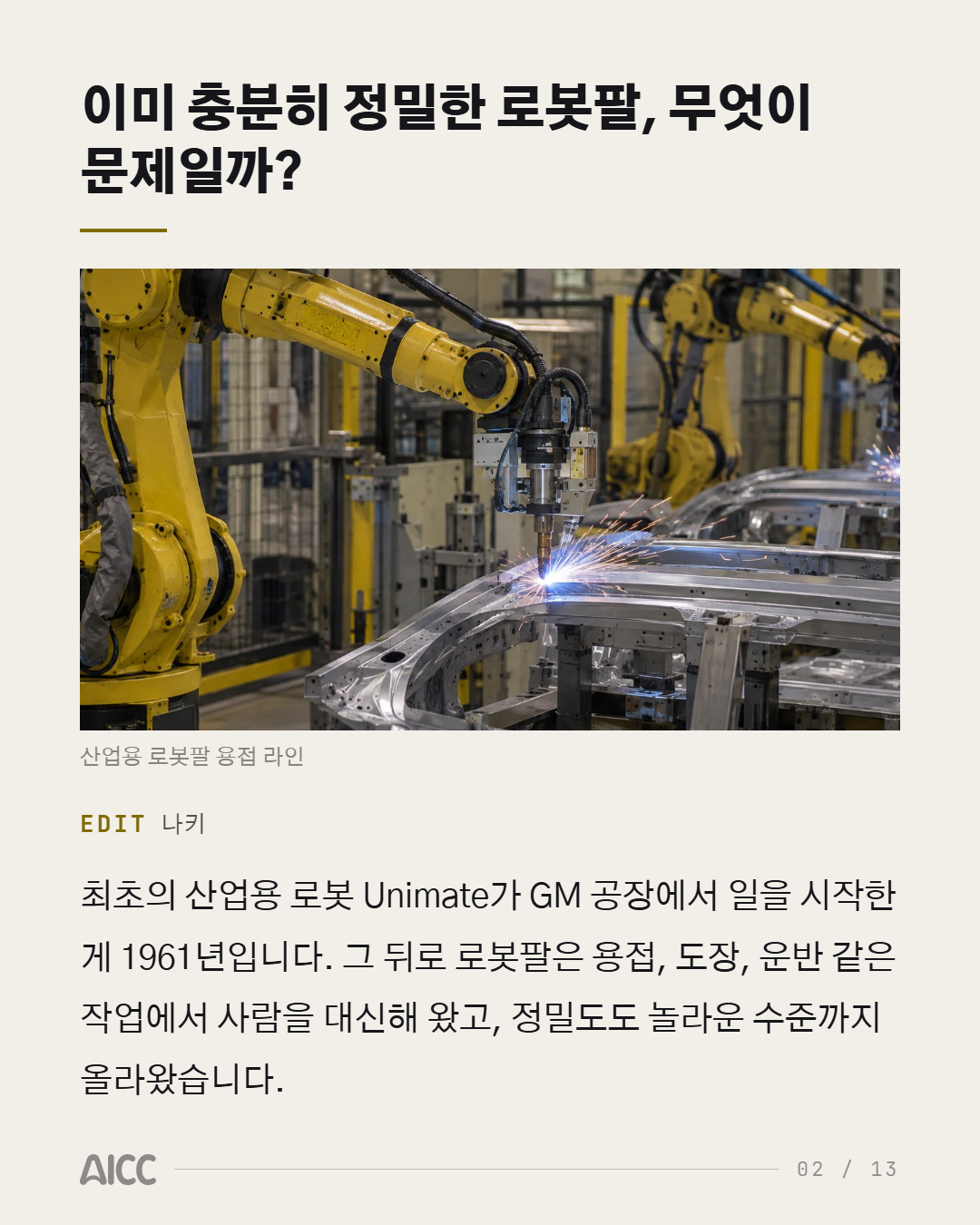
The first industrial robot, Unimate, began working at a GM plant in 1961. Since then, robotic arms have been replacing humans in tasks such as welding, painting, and material handling, and their precision has reached an astonishing level.
However, we must pay close attention to the word “repetition” here. This precision refers to the ability to return exactly to the coordinates previously taught by a human, not the ability to adapt to a situation it has never encountered before. Without separate recognition or correction functions, even if a part is placed just a few millimeters off-center on the conveyor belt, the robot will reach for the original coordinates.
Therefore, rather than making “robots smarter,” traditional factory automation has actively utilized an approach of “adapting the environment to the robot” by using separate devices to consistently fix the position and orientation of parts. While this approach is effective on production lines churning out large volumes of the same product, it reaches its limits in high-mix, low-volume production or for unstructured tasks where the product changes frequently.
Wouldn’t installing a camera solve the problem?
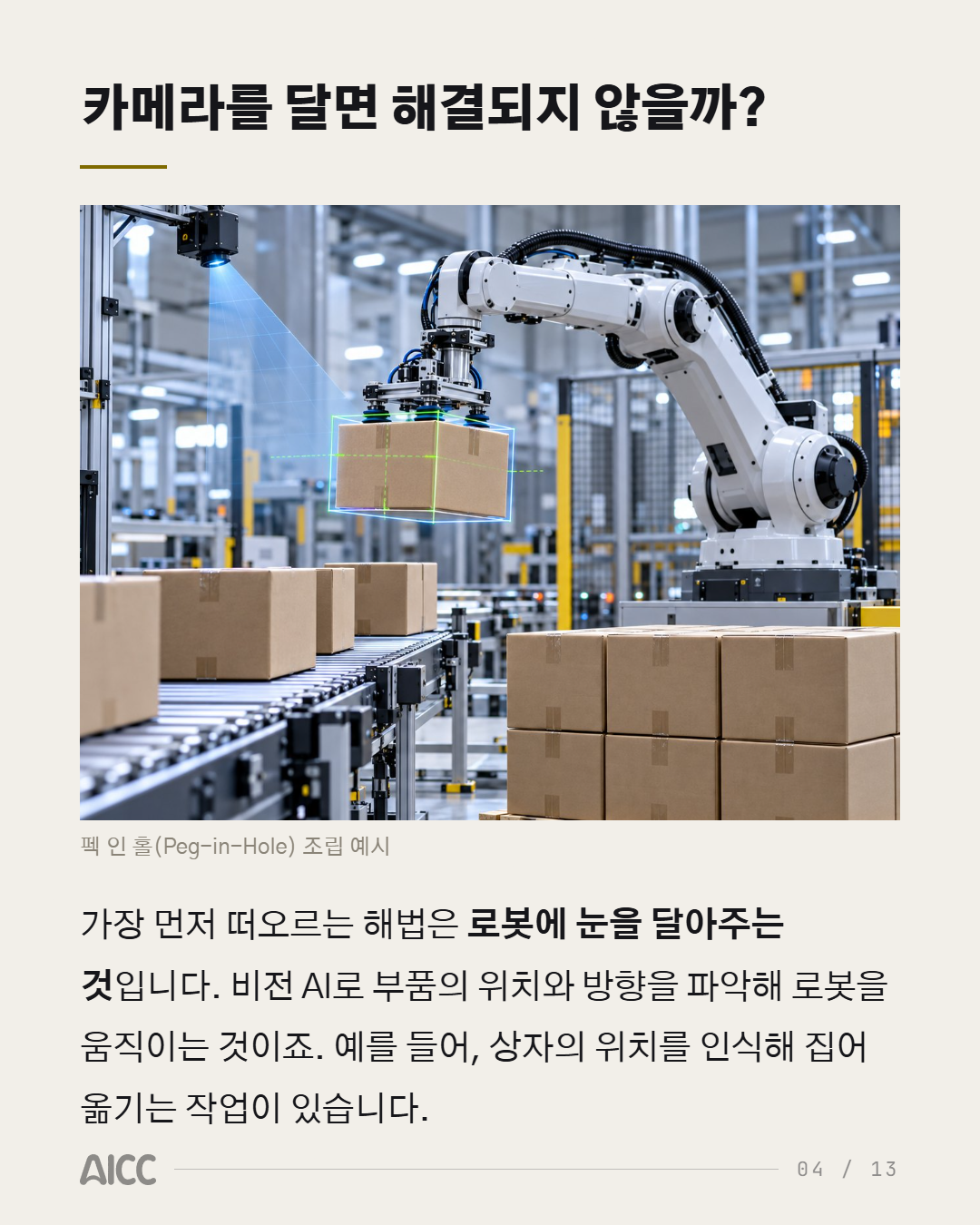
The first solution that comes to mind is equipping robots with eyes. This involves using computer vision AI to determine the position and orientation of parts and control the robot’s movements accordingly. For example, there is a task that involves recognizing the position of a box and picking it up to move it.
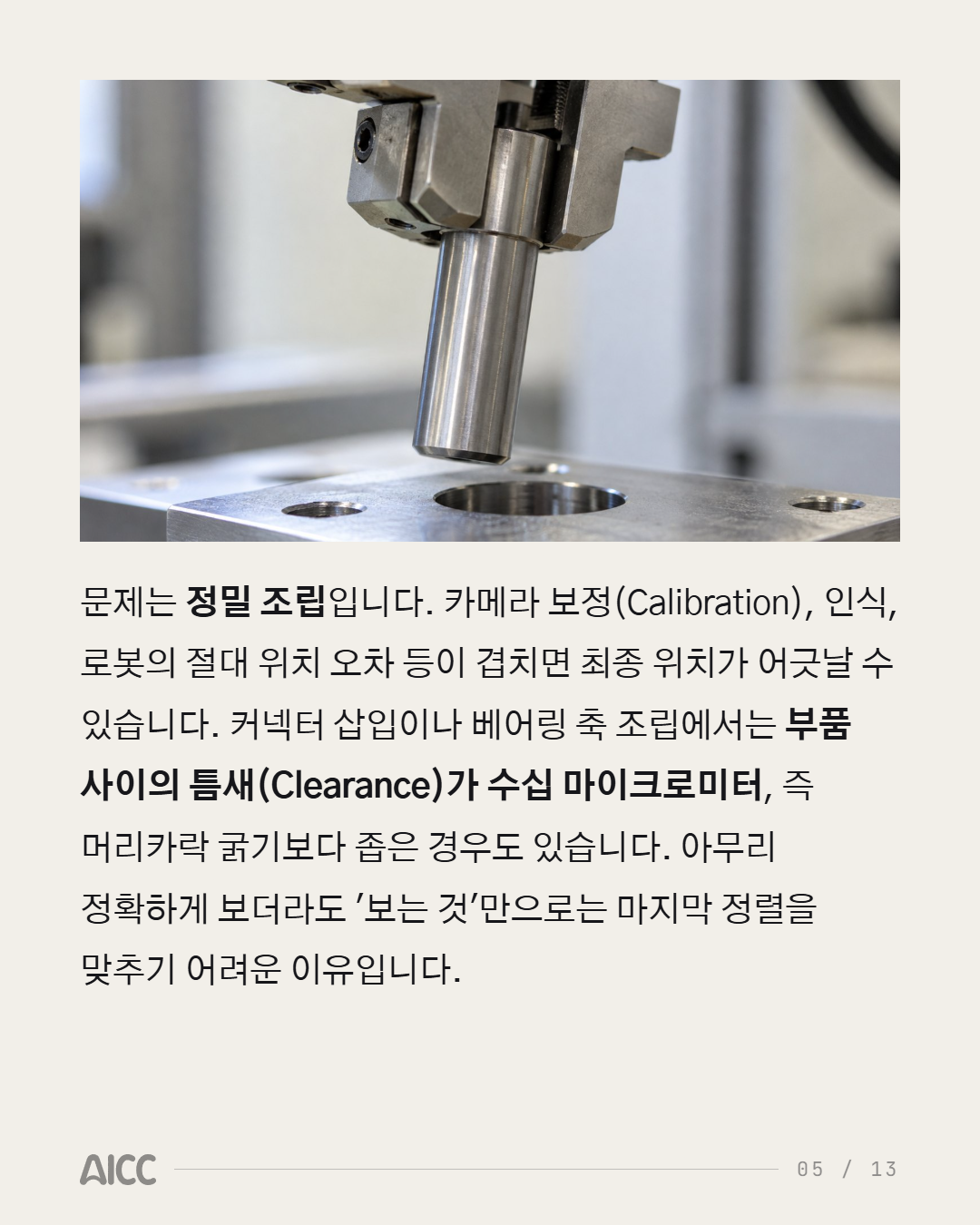
The issue is precision assembly. If factors such as camera calibration, recognition, and the robot’s absolute position error overlap, the final position may be off. In tasks such as connector insertion or bearing shaft assembly, the clearance between parts can be as small as tens of micrometers—narrower than the thickness of a human hair. This is why, no matter how precisely one looks, it is difficult to achieve the final alignment based on visual inspection alone.
Why Rigid Robots Are Actually More Dangerous
This reveals a more fundamental problem. Traditional robotic arms primarily use position control to precisely track the target position. But what happens if the robot continues to push a part into place without adjusting its movement in response to contact, even when the part is slightly misaligned? Even a small positional discrepancy can generate significant force, causing the part to jam, get scratched, or—in severe cases—be damaged.
People behave differently. When plugging in a USB drive, we don’t precisely calculate the position of the port. We hold it roughly in place, wiggle it slightly, and tilt it, using the “feel” at our fingertips to find the right spot. The human hand isn’t fixated on a specific position; it possesses a “softness” that causes it to naturally pull back when it encounters resistance.
Treating Robots Like Springs: Impedance Control
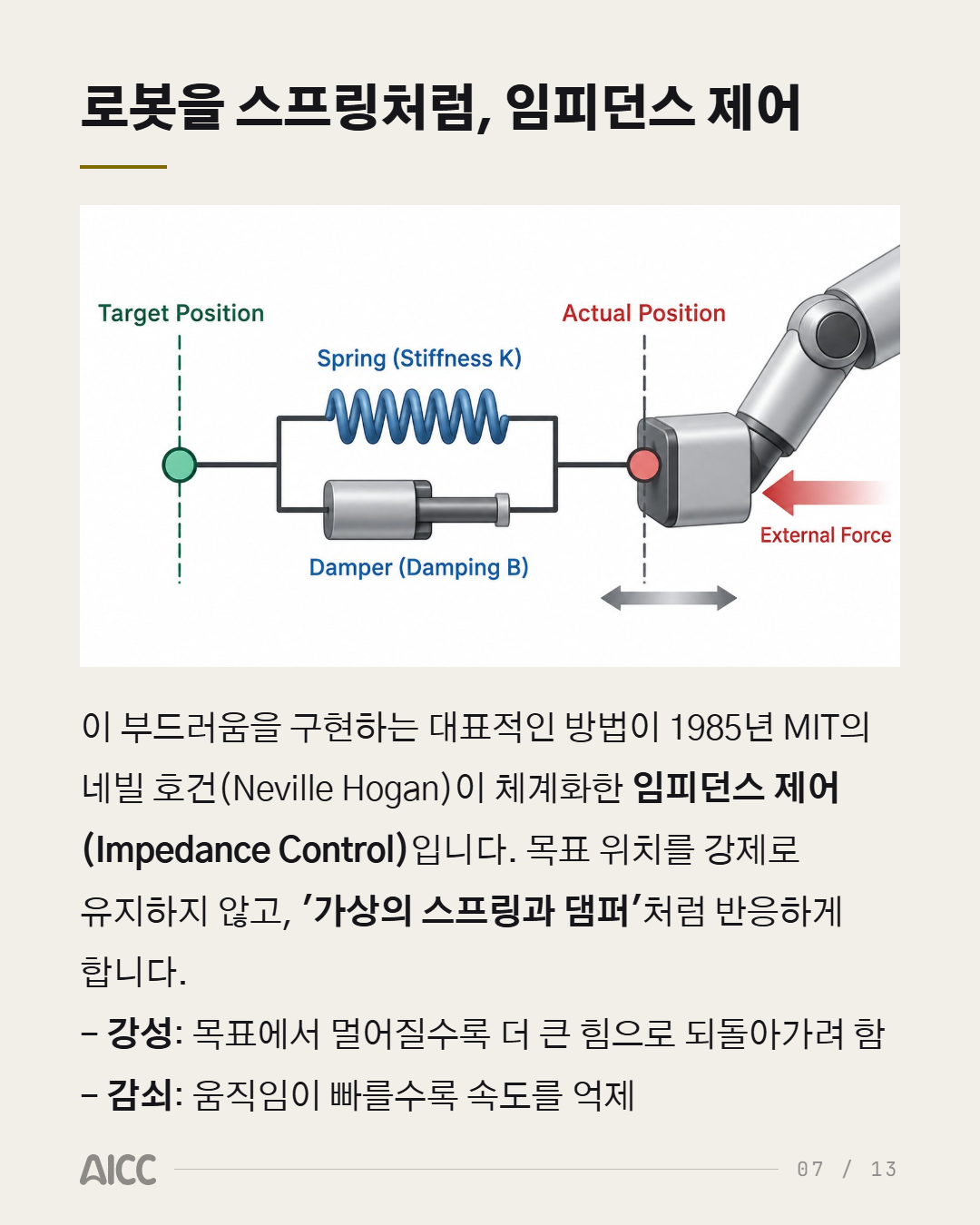
A prime example of how this smoothness is achieved is Impedance Control, a method systematized by Neville Hogan of MIT in 1985. Rather than forcibly holding the target position, it causes the system to respond like “virtual springs and dampers.”
- Stiffness: The further one strays from a goal, the greater the force driving one back toward it
- Damping: The faster the movement, the more it is slowed down
This way, when the robot encounters a part, it doesn’t simply push forward blindly but responds flexibly to external forces. By combining this with appropriate insertion motions or exploration strategies, it can compensate for minor positional errors and successfully insert the part.
A similar concept can be found in the RCC (Remote Center Compliance) device developed by the Draper Laboratory in the United States in the 1970s. This method uses the elastic structure of the robot’s wrist to help align parts with holes. While RCC achieved flexibility through a mechanical structure, impedance control differs in that it regulates the relationship between motion and force.
The Remaining Challenge: “How Soft Should It Be?”
However, there are challenges involved in impedance control as well. Success or failure depends on how much stiffness is set. If it is too stiff, the component may break; if it is too soft, there may not be enough force, resulting in insertion failure or the component being pushed into the wrong position.
What makes it even more challenging is that the appropriate stiffness varies depending on the stage of the operation. It must move quickly and accurately during transit, be gentle enough to absorb shock upon initial contact with a part, and adjust its stiffness according to the direction during insertion. Traditionally, a skilled engineer had to manually tune the control parameters, which was one of the hidden costs of assembly automation.
AI Tunes the Fingertip Feel
This is precisely where AI is gaining attention as a new solution. Of course, AI isn’t strictly necessary for adjusting stiffness. It’s possible to pre-program the mechanism to move gently during contact and firmly during insertion. However, it’s difficult to design rules every time the characteristics of the parts or the contact conditions change.
Consequently, recent research has been conducted on using signals from force and torque sensors (F/T sensors) or tactile sensors on robotic wrists to enable AI to learn context-appropriate movements and stiffness. This approach is related to Variable Impedance Learning and is being actively researched in the field of robotic manipulation involving frequent contact.
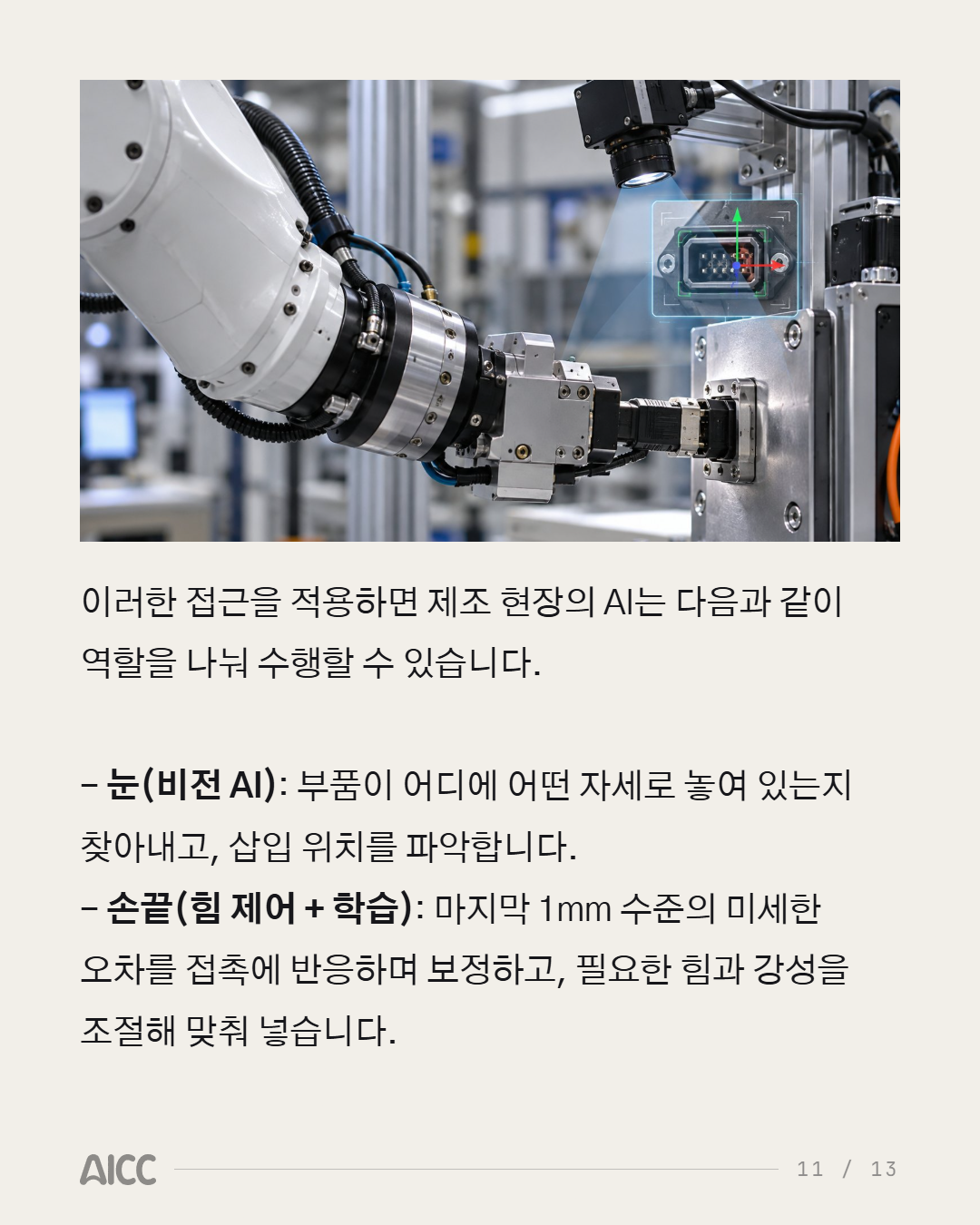
By applying this approach, AI in manufacturing environments can perform the following roles:
- Vision (Vision AI): Identifies where components are located and in what orientation, and determines their insertion positions.
- Fingertips (Force Control + Learning): They correct minute errors—down to the last 1 mm—in response to contact and adjust the required force and stiffness to ensure a precise fit.
Not a “robot that sees better,” but a “robot that feels better”
While factory automation over the past few decades has focused on keeping the environment stable to ensure precise robot movements, AI-driven manufacturing transformation (AX) is also focusing on the development of robots that can sense and adapt on their own even when their position is slightly off.
While flashy vision AI is grabbing the spotlight, the success or failure of actual production lines may, surprisingly, hinge on a small sensor at the tip of a robot’s wrist and the age-old control issue of “how smoothly it responds.” When robots finally develop a “feel” for their movements, just like humans do, won’t the dark factory be one step closer to becoming a reality?
Tags
- #artificial-intelligence
- #ai-papers
- #robot
- #mechanical-engineering
- #tactile
- #camera
- #environment