Mom, why don't we have an Optimus Prime at our house?
Physical AI: The Fourth Step, and Where Korea Stands








Robots in movies can even transform, but real-world physical AIs can’t do that yet. Why is it that an AI that can write so well can’t even pick up a cup?
AI is currently climbing the fourth step
Each step had its limits, and those limits led to the next step.
- Recognition AI — It only recognizes
- Generative AI — Creates content only on-screen (ChatGPT stage)
- Agentic AI — It doesn’t have hands yet
- Physical AI — It’s finally stepped out of the screen
If you put AI into a robot, is it physical AI?
If it has only a body (sensors, joints, motors), it is a conventional industrial robot that merely repeats predetermined commands; if it has only a brain (cognition, judgment, and action), it is a chatbot confined to a screen.
No. What matters isn’t the robot’s appearance. Only when it understands the laws of physics, its environment, time, and inertia—and makes its own judgments—can it truly be called a physical AI. Just one of these isn’t enough.
It was a single remark by Jensen Huang that set this all in motion.
“The ‘ChatGPT moment’ for general robotics is just around the corner” — Jensen Huang, CES 2025 Keynote (Jan. 6, 2025)
On this stage, NVIDIA unveiled Cosmos. It is an AI model that interacts with the physical world by learning from 20 million hours of video—essentially a large-scale version of the world model we discussed in the previous episode. Jensen Huang stated that Physical AI will reshape the manufacturing and logistics industries, which are worth $50 trillion.
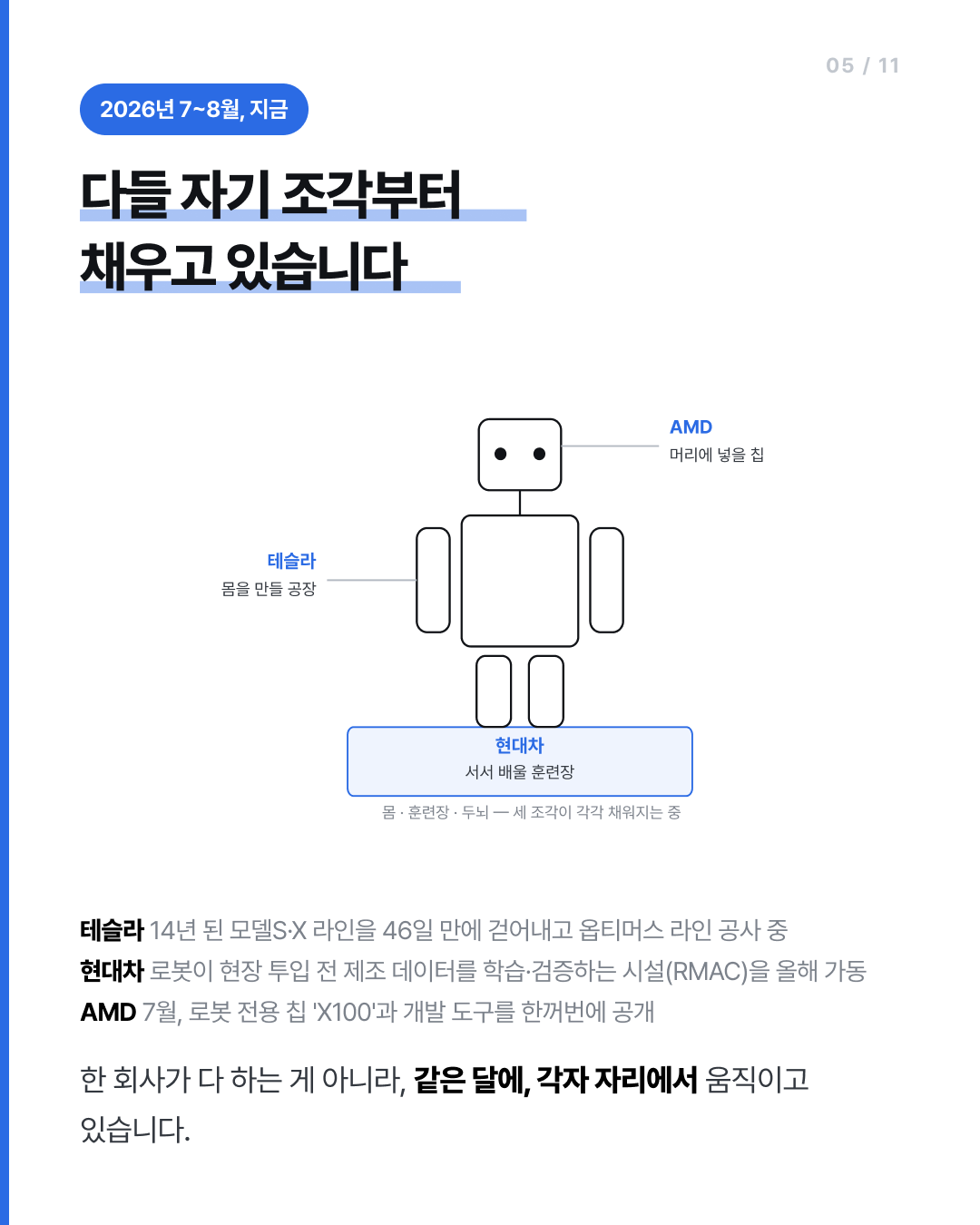
Everyone is starting with their own piece (July–August 2026)
- Tesla — Phased out the 14-year-old Model S and X lines in 46 days; construction on the Optimus line is underway
- Hyundai Motor — A facility (RMAC) where robots learn and validate manufacturing data before being deployed on the production floor will begin operations this year
- AMD — In July, the company unveiled its “X100” robot-specific chip and development tools all at once
It’s not one company doing everything; each is making its own moves this month, in its own lane. Tesla is building the factory that forms the body; Hyundai Motor is building the training ground where it learns to stand; and AMD is building the chip that goes into the head — three pieces, each falling into place.
The factory is being built, but it doesn’t have a brain yet.
“It’s a very complex problem. No one has managed to solve it yet” — Elon Musk on Optimus · Q2 2026 Earnings Call
Not only are there over 10,000 parts, but the supply chain also needs to be rebuilt from scratch. Even during the second-quarter earnings call, there was no mention of a mass production timeline, and the outlook is that general sales won’t be possible until late 2027. The first year of mass production is not the finish line—it’s just the starting line.
So why does it take so long?
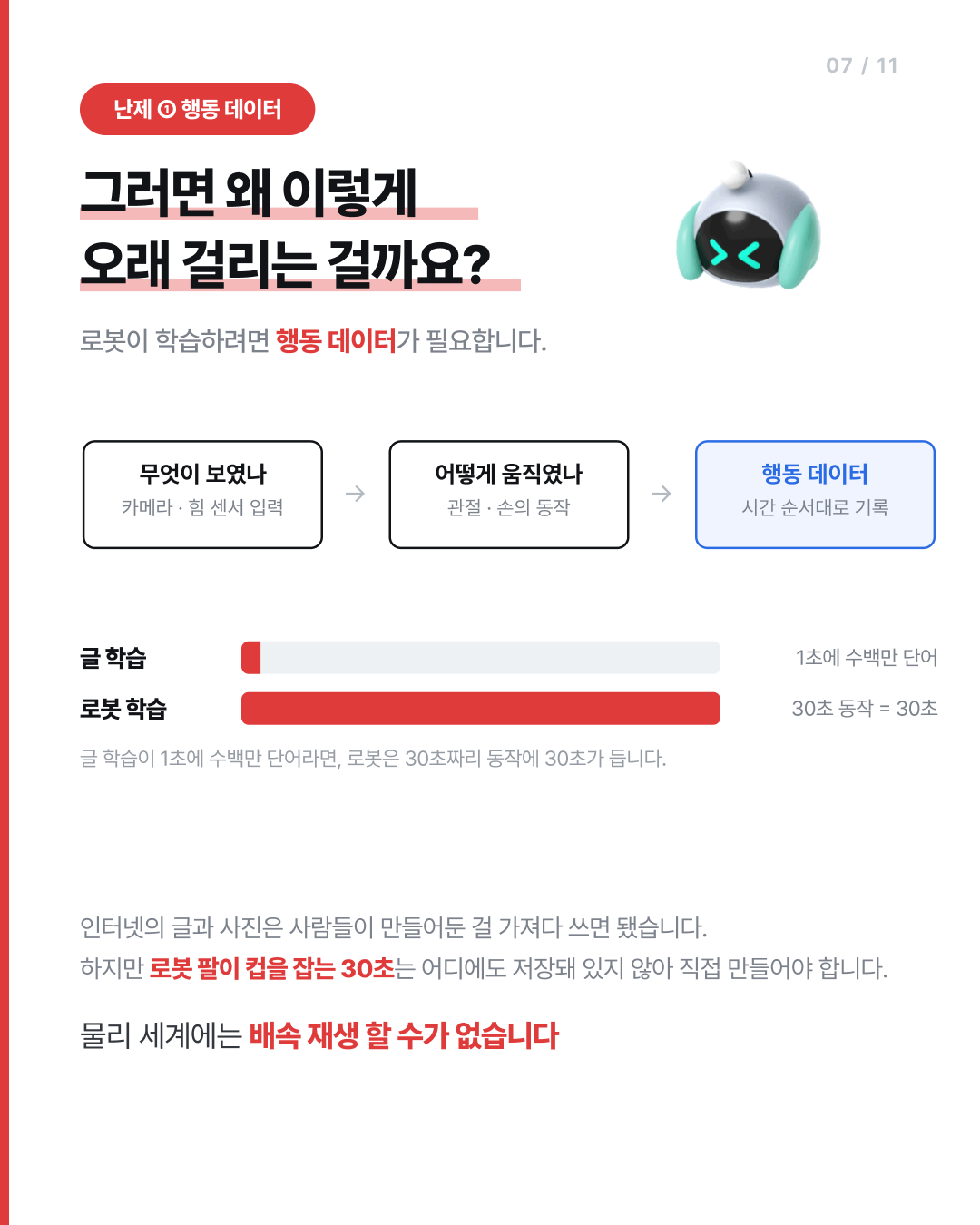
For a robot to learn, it needs action data. While learning text involves processing millions of words per second, a robot takes 30 seconds to perform a 30-second action. While we could simply use text and images from the internet that people had already created, the 30 seconds it takes for a robotic arm to grasp a cup isn’t stored anywhere, so we have to create it ourselves. There’s no such thing as fast-forward playback in the physical world.
What you learn in a virtual environment is different from what you learn in real life.
It took NVIDIA 11 hours to generate 780,000 movements virtually, but it would take a person 9 months to collect the same amount of data (6,500 hours). When synthetic data was used alongside real data for training, performance improved by 40%; however, the real world is not as orderly as a simulation, and exceptions—such as object deformation and mechanical play—constantly occur. This discrepancy is referred to as the Sim2Real Gap.
Here, a mistake isn’t a typo — it’s an accident.
If a chatbot gets it wrong, you can simply ask again, but if a robot gets it wrong, it can mean damage or a safety incident that can’t be undone. That’s why the key isn’t a single success, but reliability—the ability to succeed consistently even when conditions change slightly. We don’t need smart robots; we need robots we can trust.
So where does Korea fit into this picture?
The United States holds the advantage in foundation models, semiconductor design, and capital, while China holds the advantage in component supply chains, a massive domestic market, and vast amounts of data. South Korea’s strengths lie in its manufacturing facilities—which are among the most technically challenging in the world—the data they generate, its competitiveness in components, and the speed at which it conducts field testing and integration.
- Strengths — Manufacturing data accumulated on the factory floor: an asset that other countries cannot buy with money
- Weak links — Action data and simulation, robot foundation models, and software talent
Last June, the government also launched the second phase of the Physical AI Alliance, identifying the development of a full-stack platform, the establishment and support of training centers, and the revision of relevant laws and regulations as its core tasks.
“It’s almost as if we can build the body but have to buy the brain” — Professor Yoo Chang-dong of KAIST
Tags
- #artificial-intelligence
- #physical-ai
- #robot
- #humanoid
- #tech-news